First Microsoft. Then Airports. Now Banks.
November 17, 2026 · krasystec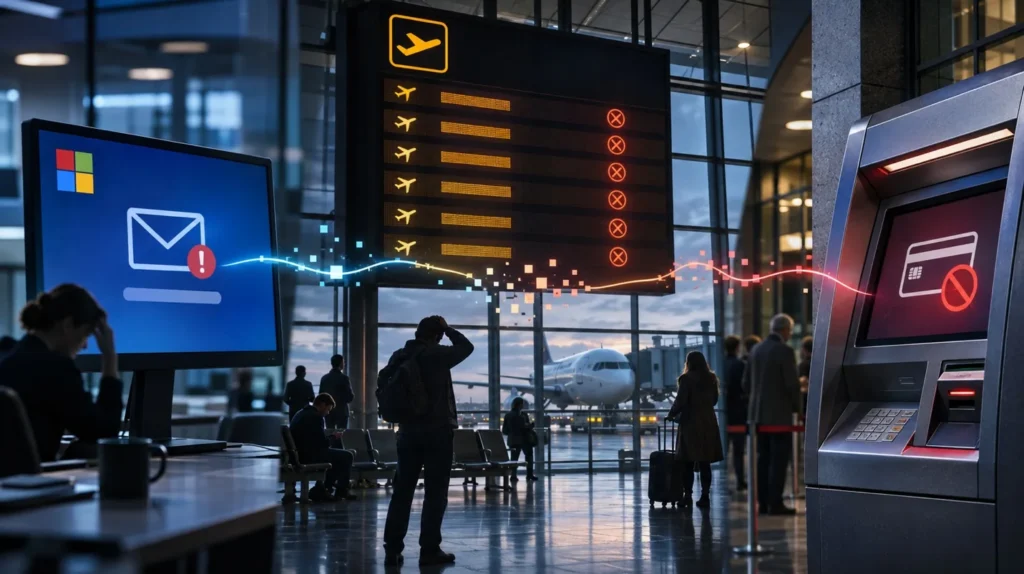
An email that will not send. A departure board filling with cancellations. A banking app that will not load.
Over the past several days, disruptions affecting Microsoft services, US air travel and banking transactions have brought the fragility of everyday infrastructure into sharp focus. Activities people usually take for granted—working, travelling and moving money—have suddenly depended on technical problems being resolved somewhere beyond their control.
There is no established evidence linking all three incidents to a single cause. Their significance lies in what they reveal collectively: when essential systems become unavailable, how much of ordinary life can still function?
Three disruptions, one public concern
The Microsoft disruption began on November 12, affecting Outlook, Teams and other services used by businesses and public institutions worldwide. Microsoft reported server problems and said it was not aware of malicious activity. Some organisations resorted to telephone calls, paper records and fax machines to keep work moving.
On November 13, a telecommunications failure affecting US air traffic control prompted a nationwide ground stop. The disruption continued to affect passengers through the weekend as airlines dealt with cancellations and delays.
Then, on November 16, banking customers reported difficulties accessing online services and completing payments. Associated Press reported that a technical issue at JPMorgan Chase caused transaction delays, including some involving other financial institutions. Chase said the problem was not a cyberattack and that customers retained access to their accounts and funds. Other institutions reported that their own systems were functioning normally, although some transfers could be delayed.
These distinctions are essential. Reports of problems across several banking platforms do not establish that every institution suffered a separate outage. Nor does the timing of these events prove coordination.
Nevertheless, their proximity has made a broader concern difficult to ignore: essential services can become inaccessible even without a confirmed attack.
When convenience becomes dependence
Digitalisation has removed countless obstacles from daily life. Work crosses borders instantly. Journeys can be booked in minutes. Payments move without a visit to a branch.
But as these services become the default, alternatives can become harder to find.
An unavailable platform can leave customers searching for telephone numbers, employees improvising ways to communicate and travellers waiting for information that staff may themselves struggle to obtain.
The consequences are uneven. Some people can postpone a payment or work around a cancelled meeting. Others face missed wages, disrupted care arrangements, unexpected accommodation costs or a transaction that cannot wait.
What an institution describes as a temporary interruption can become a serious personal problem.
Reliability therefore needs to be treated as part of the service itself. A banking platform must offer more than convenience when it works. An essential communications system must be judged on more than its normal performance.
The arrangements for failure matter too.
The accountability gap
Modern services rely on layers of suppliers, networks and infrastructure. Customers interact with a familiar brand, while the systems supporting it may involve several organisations.
When something fails, that structure can make responsibility difficult to follow. A service provider may be waiting for a contractor, a software company or a network operator. The customer, meanwhile, still needs to travel, communicate or pay.
For governments and regulators, this raises questions about oversight. How thoroughly are contingency plans tested? Can backup services operate independently? How quickly must institutions explain what is affected and what customers can do?
For businesses, it raises an equally practical question: does a continuity plan work under pressure, or does it assume access to the very tools that have stopped functioning?
The return to phones and fax machines during the Microsoft disruption offered a useful reminder. Older technology can remain valuable when it provides a genuinely separate way to complete an essential task.
Restoration is only the first step
A notification announcing that service has resumed marks the end of an outage. It should also begin a public explanation.
Customers deserve to know what failed, how the damage was contained and what will change. Clear communication is particularly important when several disruptions occur close together, creating space for speculation to outrun verified information.
The lesson from Microsoft, aviation and banking is that digital progress requires sustained investment in resilience: independent backups, usable alternatives, tested procedures and people empowered to respond.
The question is no longer simply whether a service is available online.
It is whether people can still access what they need when it is not.
https://highlightreview.com/first-microsoft-then-airports-now-banks/