The World’s Backup Plan Is Buried in the Arctic
November 17, 2026 · krasystec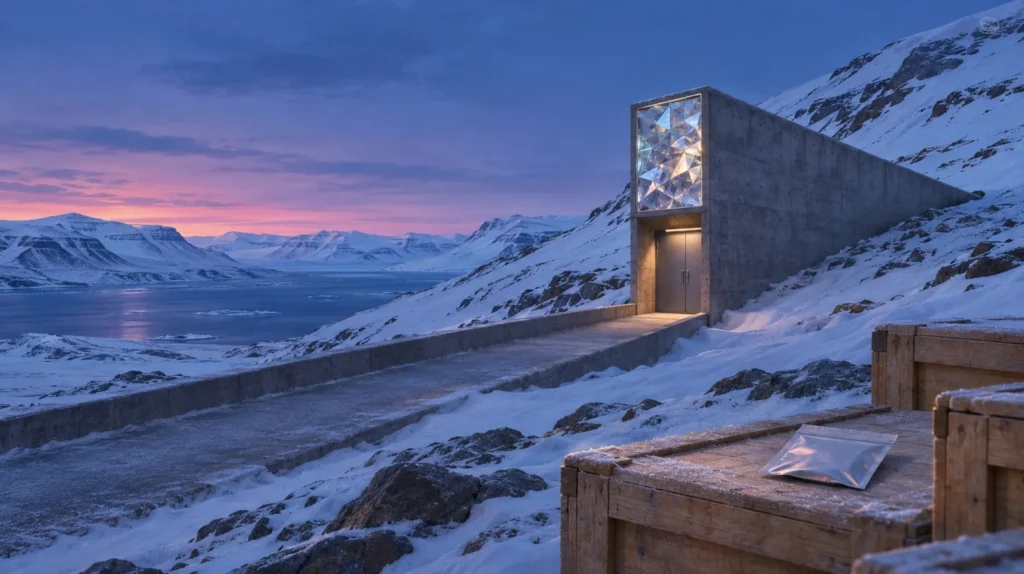
The first time the world’s most famous seed vault was asked to return part of its collection, humanity had not experienced an apocalypse.
There had been no global collapse. No asteroid.
There was a war in Syria.
In 2015, the International Center for Agricultural Research in the Dry Areas, known as ICARDA, withdrew backup seeds from the Svalbard Global Seed Vault after conflict disrupted its work in Syria. Those seeds helped rebuild collections in Lebanon and Morocco.
The facility often nicknamed the “doomsday vault” had demonstrated a more immediate purpose: helping scientists recover from a disaster already happening.
What is inside the mountain?
Opened by Norway in February 2008, the vault sits in the Arctic archipelago of Svalbard, approximately 1,300 kilometres beyond the Arctic Circle. Its chambers hold seed samples sent by institutions around the world for long-term safekeeping.
These are backup copies of collections maintained elsewhere. The vault provides another layer of protection against conflict, natural disasters, equipment failure and other emergencies. It does not replace the working genebanks that conserve and supply seeds for research and agriculture.
Think of it as an off-site backup for part of humanity’s food system.
Why save different versions of the same crop?
“Wheat” is a category, not one identical plant. Crop collections preserve varieties, farmers’ traditional populations, breeding material and wild relatives that may contribute useful characteristics to future crops.
Their value extends beyond the harvest they could produce today. Genetic differences give researchers and breeders options when developing crops for changing conditions.
Losing a collection can therefore mean losing possibilities—some of whose importance may only become clear years later.
A seed packet is small. What it preserves can be much larger.
Why the Arctic?
Cold storage helps keep suitable seeds viable for longer.
The vault uses mechanical refrigeration to maintain approximately −18°C. The surrounding permafrost provides an additional buffer, helping keep samples frozen for a long time if artificial cooling stops.
But the facility still needs engineering and maintenance. Improvements completed in 2019 included waterproofing the entrance tunnel and adding exterior drainage to prevent water intrusion.
Even a backup needs protection.
Who owns the seeds?
Norway owns the facility, which operates through a partnership involving its agriculture ministry, the Nordic Genetic Resource Center, NordGen, and the Crop Trust.
Depositing seeds does not transfer ownership. Under its “black box” arrangement, institutions retain ownership and control over their material.
That distinction is essential to international cooperation: institutions can safeguard their collections without surrendering them.
The seeds that returned to the fields
ICARDA’s first withdrawal involved 38,073 seed samples, which arrived in Lebanon and Morocco and were sown in November 2015.
Growing them produced fresh seed for active collections—and new backups. By September 2019, ICARDA had deposited 42,729 regenerated samples in Svalbard since 2017, many produced using material retrieved from the vault.
The process turned stored genetic resources back into living plants. The backup had become the starting point for rebuilding.
What the vault cannot save
Svalbard is not a warehouse of food ready to feed the world. It stores seeds, and recovery requires people, land, functioning institutions and time.
Nor can every crop be preserved through the same frozen-seed approach. NordGen notes that crops commonly propagated through plant material, including potatoes and bananas, present different conservation needs.
The vault is one part of a wider conservation system.
Its most compelling story is therefore about cooperation: researchers safeguarding collections, institutions maintaining backups and people growing seeds again when circumstances allow.
Buried in an Arctic mountain is something more useful than a prediction of the world’s end.
It is a way to preserve choices for what comes next.
https://highlightreview.com/the-worlds-backup-plan-is-buried-in-the-arctic/