The Internet Is Under the Sea. Who Protects It?
November 17, 2026 · krasystec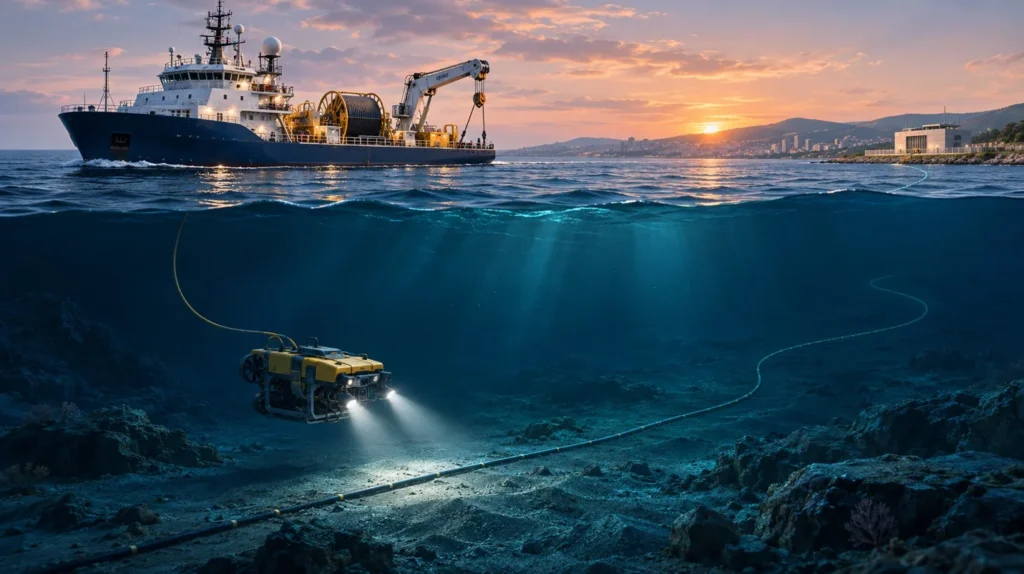
We call it “the cloud.” We connect through “wireless” networks. Our digital lives seem almost weightless.
Yet a message crossing an ocean usually depends on something physical: a fibre-optic cable lying on the seabed.
Submarine cables carry more than 99% of international data traffic, according to the International Telecommunication Union. They support everything from video calls and streaming to financial transactions and government communications. Satellites have an important role, but cables carry the overwhelming share of international traffic.
The infrastructure behind our connected world is remarkably easy to overlook—until something goes wrong.
Smaller than you might imagine
These are not enormous underwater tunnels.
Telecommunications cables contain optical fibres protected by layers of material. Some are roughly the thickness of a garden hose, with construction varying according to the conditions they must withstand. In deep water, cables can rest directly on the seabed. In shallower areas, they are often buried for protection.
They connect to shore through landing points, linking the underwater network to infrastructure on land.
Their importance makes an obvious question surprisingly difficult to answer: who is responsible for keeping them safe?
There is no single guardian
Private companies and groups of companies own and operate much of the submarine internet network. Protection depends on cooperation between those operators, governments, maritime authorities and specialist maintenance providers.
The work begins before a cable is installed: choosing routes carefully, identifying hazards and deciding where additional protection is needed.
Once operational, cables benefit from maritime awareness programmes, monitoring and restrictions on activities such as anchoring in designated areas. Governments can also use vessel tracking, surveillance and patrols to help protect vulnerable infrastructure.
But protecting a vast underwater network requires more than watching ships. It also means preparing for damage that cannot always be prevented.
Most breaks are not sabotage
Cable damage can sound like the opening scene of a geopolitical thriller. The most common causes are more ordinary.
The International Cable Protection Committee estimates that approximately 150–200 telecommunications cable faults occur globally each year. Around 70–80% result from accidental human activity, principally fishing and ships’ anchors. Natural hazards and technical failures also cause damage.
Deliberate interference remains a security concern. However, a broken cable is not, by itself, evidence of an attack. Establishing the cause requires investigation.
What happens when one breaks?
A damaged cable does not automatically disconnect a country.
Where alternative connections and sufficient capacity exist, traffic can take another route. Users may notice little or nothing. Where backup options are limited—or several connections fail together—the effects can be much more serious.
In March 2024, multiple cable cuts off West Africa disrupted connectivity across several countries, including Ghana, Liberia and Côte d’Ivoire. The incident demonstrated the importance of having genuinely different routes available.
The crucial distinction is between having a connection and having alternatives when it fails.
Repairing the connection takes a ship
Restoring a damaged submarine cable requires specialist vessels, equipment and marine engineering crews.
The industry maintains repair arrangements and strategically positioned ships. Even so, recovery can be delayed by vessel availability, travel distances, permits and customs procedures. Repairs can take weeks or, in difficult circumstances, months.
A technical problem underwater can therefore become a logistical problem above it.
The strongest protection is having another way through
More resilient connectivity means geographically diverse cable routes, different landing points, land-based alternatives where possible and the ability to repair damage quickly. Locally hosted content can also reduce dependence on distant connections.
In July 2026, an international advisory body established by the ITU and the cable protection committee approved recommendations addressing these challenges, including repair delays and countries’ dependence on a small number of systems.
For users, the internet arrives through a screen. Behind that screen are physical routes, ships, engineers and international cooperation.
The question is not whether an underwater cable will ever break. They break regularly. The question is whether the network has another way to keep us connected.
https://highlightreview.com/the-internet-is-under-the-sea-who-protects-it/