


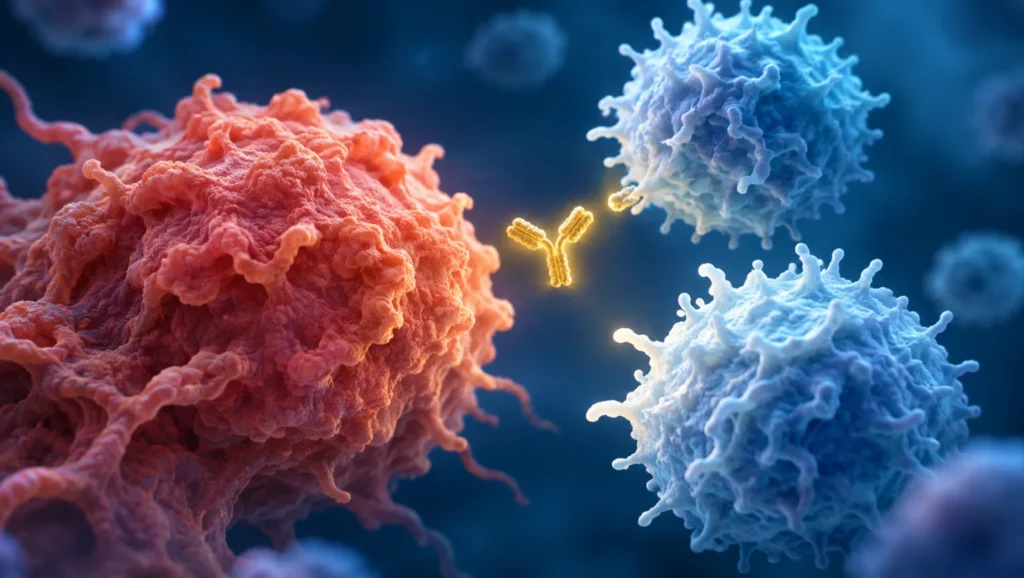
For some people diagnosed with rectal cancer, treatment may now begin with a different conversation: could immunotherapy control the disease without chemotherapy, radiation, or surgery?
On October 19, 2026, the U.S. Food and Drug Administration granted accelerated approval for a new use of dostarlimab, marketed as Jemperli. The approval covers adults with stage II or III locally advanced rectal cancer whose tumors have particular DNA-repair abnormalities, identified through an authorized test.
It is a significant development for selected patients—not a treatment for every cancer or every case of rectal cancer.
How does it work?
Dostarlimab is an immunotherapy that targets PD-1, a protein on immune cells. Blocking this pathway can help the immune system attack cancer.
The newly approved use concerns tumors described as mismatch repair deficient, or dMMR, or microsatellite instability-high, known as MSI-H. These abnormalities allow errors to accumulate when cancer cells copy their DNA, potentially making the tumors more recognizable to the immune system.
Testing is therefore central to eligibility. A diagnosis of rectal cancer alone does not establish that the treatment is appropriate.
What did the research show?
The FDA reviewed results from AZUR-1, a study involving 154 patients with previously untreated, locally advanced MSI-H or dMMR rectal cancer.
According to the agency, 110 patients—71 percent of those treated—received dostarlimab alone, had no additional treatment, and had not experienced disease progression at the analysis cutoff. Others required surgery, additional systemic treatment, or radiation, and some withdrew or were lost to follow-up.
An earlier study published in the New England Journal of Medicine also attracted attention. All 49 rectal-cancer patients who completed treatment achieved a clinical complete response and chose nonoperative management. Thirty-seven had maintained that response for at least 12 months at the time of analysis.
A clinical complete response means assessments find no detectable cancer. It does not establish that the disease can never return.
Why avoiding surgery matters
Standard rectal-cancer treatment can involve chemotherapy, radiation, and surgery. These treatments can have lasting effects on bowel, urinary, and sexual function, and some patients require a permanent colostomy.
For eligible patients who respond to immunotherapy, avoiding those interventions could preserve important aspects of everyday life. However, nonoperative management involves continuing surveillance, rather than simply finishing medication and ending medical follow-up.
Benefits come with risks and unanswered questions
Dostarlimab can cause immune reactions against healthy organs and tissues, which may be severe or fatal. Common side effects in this patient group included fatigue, rash, diarrhea, and itching.
The accelerated approval also requires further evidence. The FDA has directed the manufacturer to continue studying response durability, recurrence, organ preservation, and longer-term survival.
The advance offers a meaningful possibility for a narrowly defined group. Whether it is suitable for an individual depends on tumor testing and specialist assessment. U.S. approval does not automatically establish availability or coverage in Lebanon or other countries.
 Sleep Is About More Than the Number of Hours in BedNovember 5, 2026
 Solar Power Is Growing. What Happens to the Batteries When They Wear Out?November 5, 2026