

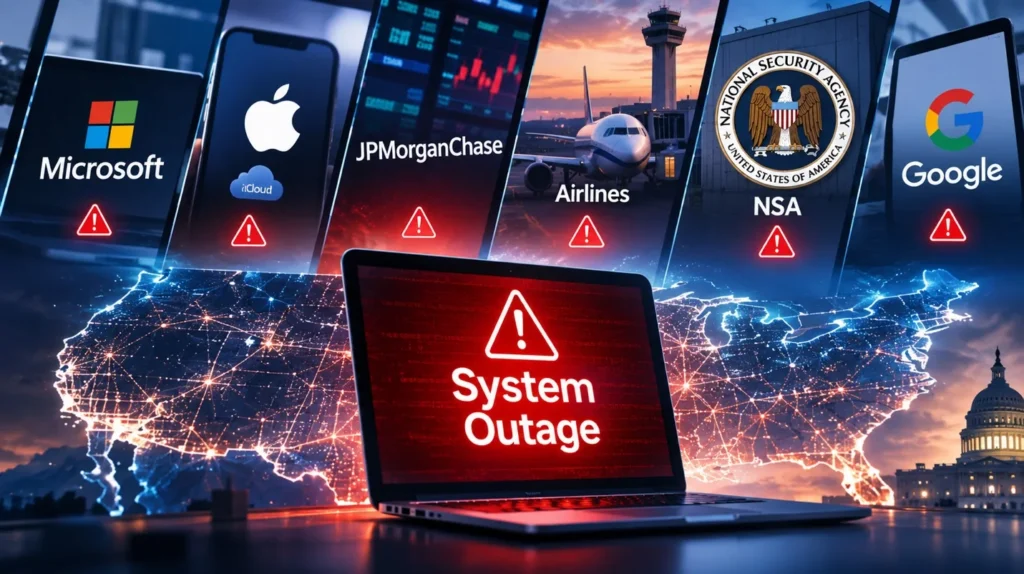

First Microsoft. Then America’s aviation systems. Next came major banks, United Airlines and the National Security Agency’s classified communications network. Now, Apple has joined the growing list of technology giants experiencing widespread disruptions.
Within days, a series of high-profile outages has affected some of the world’s most important digital services, raising an increasingly urgent question: How vulnerable has our technology-dependent world become?
Although authorities have found no evidence linking these incidents to a coordinated cyberattack, their concentration has renewed concerns about the reliability of the digital infrastructure supporting modern society.
From Microsoft to Apple: A Week of Disruptions
The wave began with a major Microsoft 365 outage, disrupting Outlook, Teams, Copilot and other services relied upon by millions of businesses and individuals.
Shortly afterward, a malfunction in the Federal Aviation Administration’s communications network triggered a nationwide ground stop, causing widespread flight delays. Investigators subsequently identified faulty network equipment as the cause.
On November 16, JPMorgan Chase experienced technical problems that delayed transactions and affected customers at other major financial institutions, including users of the Zelle payment network.
That same day, United Airlines suffered a separate systems failure that temporarily prevented departing aircraft from taking off.
Then came one of the most sensitive incidents: CNN reported that NSA Net, the highly classified internal communications network used by the US National Security Agency, had gone down.
The disruption raised concerns because of the NSA’s central role in intelligence gathering and national security. However, reports indicated that essential communications remained available through backup systems.
And on November 17, Apple became the latest major technology company to experience widespread service interruptions.
Users reported problems with iCloud, Apple Pay, the App Store, Apple Music and account sign-ins. Apple attributed its confirmed outages to an internal update and said services were being restored.
Meanwhile, Gmail users also reported difficulties accessing email services, although Google had not confirmed a corresponding widespread outage.
Coincidence, Technical Failures or Something More?
The timing of these incidents has inevitably fueled speculation about whether the United States is experiencing a coordinated cyber operation.
Yet available evidence does not support that conclusion.
Microsoft, United Airlines, JPMorgan Chase and Apple have indicated that their respective disruptions were not linked to cyberattacks. US officials have also pointed to technical failures, infrastructure challenges and software-related problems.
The incidents have different reported causes, and no verified evidence establishes a connection between them.
Nevertheless, the pattern highlights a growing concern: the world’s most sophisticated digital systems can be disrupted without a single hacker being involved.
The Hidden Weakness of a Connected World
Modern society relies on an intricate web of cloud platforms, financial networks, aviation systems, communications infrastructure and increasingly automated technologies.
When one critical component fails, the consequences can extend far beyond the original problem.
A software malfunction can interrupt banking transactions. A network failure can ground aircraft. An unsuccessful update can disrupt services used by millions.
Even classified intelligence systems are not immune to technical breakdowns.
As artificial intelligence, cloud computing and automation become more deeply integrated into essential infrastructure, maintaining reliability and effective backup systems becomes increasingly important.
A Wake-Up Call for the Digital Age
The recent outages do not establish that America is under cyberattack. They do, however, reveal how dependent governments, businesses and ordinary citizens have become on systems that can fail unexpectedly.
The larger challenge is no longer simply protecting networks against hackers. It is ensuring that essential services can continue functioning when technology itself breaks down.
And after a week in which email platforms struggled, banking transactions stalled, flights were grounded, classified communications were disrupted and Apple services went offline, one question seems increasingly relevant:
If even the world’s biggest technology companies and most sensitive institutions can experience major failures, how prepared are we for a truly widespread digital breakdown?
For now, the outages appear unrelated. But collectively, they offer a powerful reminder that the digital world is only as resilient as the infrastructure holding it together.
 ترامب وشي وبوتين يجتمعون في شينزن: على ماذا اتفقوا؟November 21, 2026