

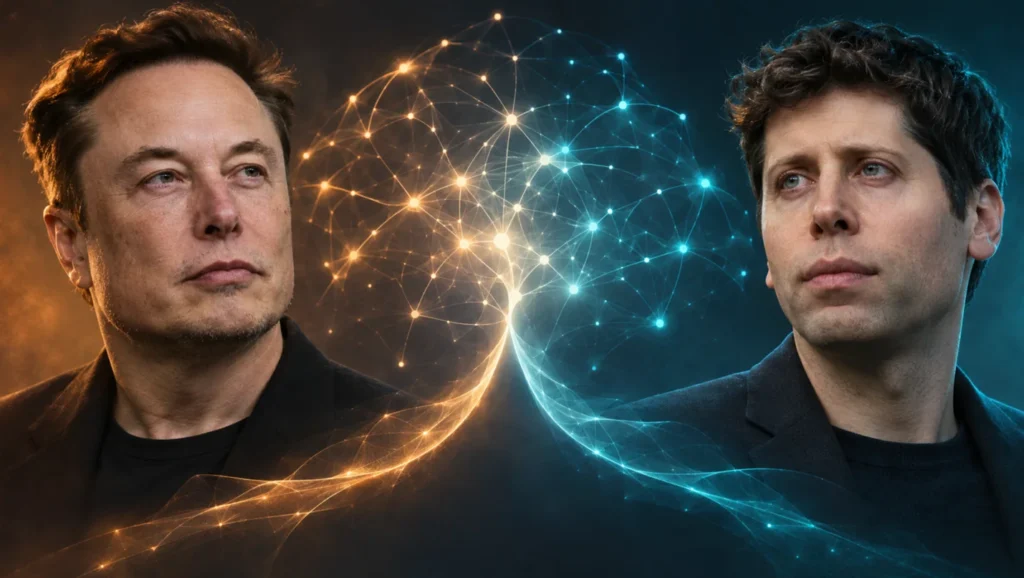
Elon Musk’s relationship with OpenAI began with a shared ambition: develop artificial intelligence for the benefit of humanity. More than a decade later, that relationship has become a confrontation involving competing businesses, accusations over the organization’s direction, and multiple legal battles.
Understanding the split requires separating three connected stories: OpenAI’s founding mission, its decisions about commercial funding, and the competition between the company and Musk’s own AI interests.
The original promise
OpenAI launched in December 2015 as a nonprofit research organization, with Musk and Sam Altman serving as co-chairs. Its founding announcement described an institution intended to advance AI without being constrained by the need to generate financial returns. It also encouraged researchers to publish their work and collaborate with other institutions.
That mission helps explain why the subsequent dispute attracted attention beyond the technology industry. The question became whether an organization established around a public-benefit purpose could bring in commercial investment while remaining faithful to its commitments.
Musk left OpenAI’s nonprofit board in February 2018. In March 2019, OpenAI announced a commercial structure that it called “capped-profit.” The company said this would help it attract the investment and talent needed for increasingly expensive research, while retaining nonprofit oversight. Those details describe the structure announced at that time.
Two competing accounts
Musk has accused OpenAI’s leadership of abandoning the organization’s charitable purpose. During the 2026 trial over those allegations, his argument centered on whether resources contributed to a nonprofit had been diverted toward private commercial interests. These were allegations contested by the defendants.
OpenAI offers a different account. It says Musk himself supported exploring a commercial structure before leaving, and that disagreements included his proposed level of control and a possible combination with Tesla. These assertions form part of OpenAI’s defense and should be understood as the company’s account of the breakdown.
The disagreement therefore involves more than whether AI development requires money. It concerns what the founders agreed, who should control the organization, and how its mission should constrain commercial decisions.
What happened in court
On May 18, 2026, a California jury found that the claims submitted to it were brought too late under the applicable statute of limitations. Reuters reported that the verdict ended that trial in OpenAI’s favor.
The distinction matters: a finding that claims were filed too late does not resolve every underlying argument about the organization’s conduct. Nor does the outcome mean every separate dispute involving Musk’s businesses and OpenAI has ended.
In September, Reuters reported that Musk’s X Corp and SpaceXAI resolved their claims against Apple in a separate antitrust case, while continuing their claims against OpenAI. That lawsuit alleged that the companies’ arrangements unfairly restricted competition. OpenAI and Apple denied wrongdoing, and Apple disputed the claim that its OpenAI integration was exclusive.
Why the rivalry matters
Musk also became a direct competitor, launching xAI in 2023. That commercial interest is relevant context when assessing his criticism, just as OpenAI’s interests matter when assessing its responses. Neither side’s public statements should substitute for independent evidence.
The broader issue is how to hold AI organizations accountable for promises made before their technology becomes commercially valuable. What should public-benefit commitments require? Who should oversee them? And how should competition be protected as powerful companies secure investment and distribution partnerships?
Musk and OpenAI give sharply different answers. Their rivalry makes those questions visible, but the consequences extend to everyone who uses—and increasingly depends on—AI.
Background and developments checked through November 2, 2026.
 AI Exposure Does Not Mean Your Job Is About to DisappearNovember 5, 2026
 Before You Share That Viral Video Check What It Really ShowsNovember 5, 2026
 The Online Checkout That Makes Saying No DifficultNovember 5, 2026