


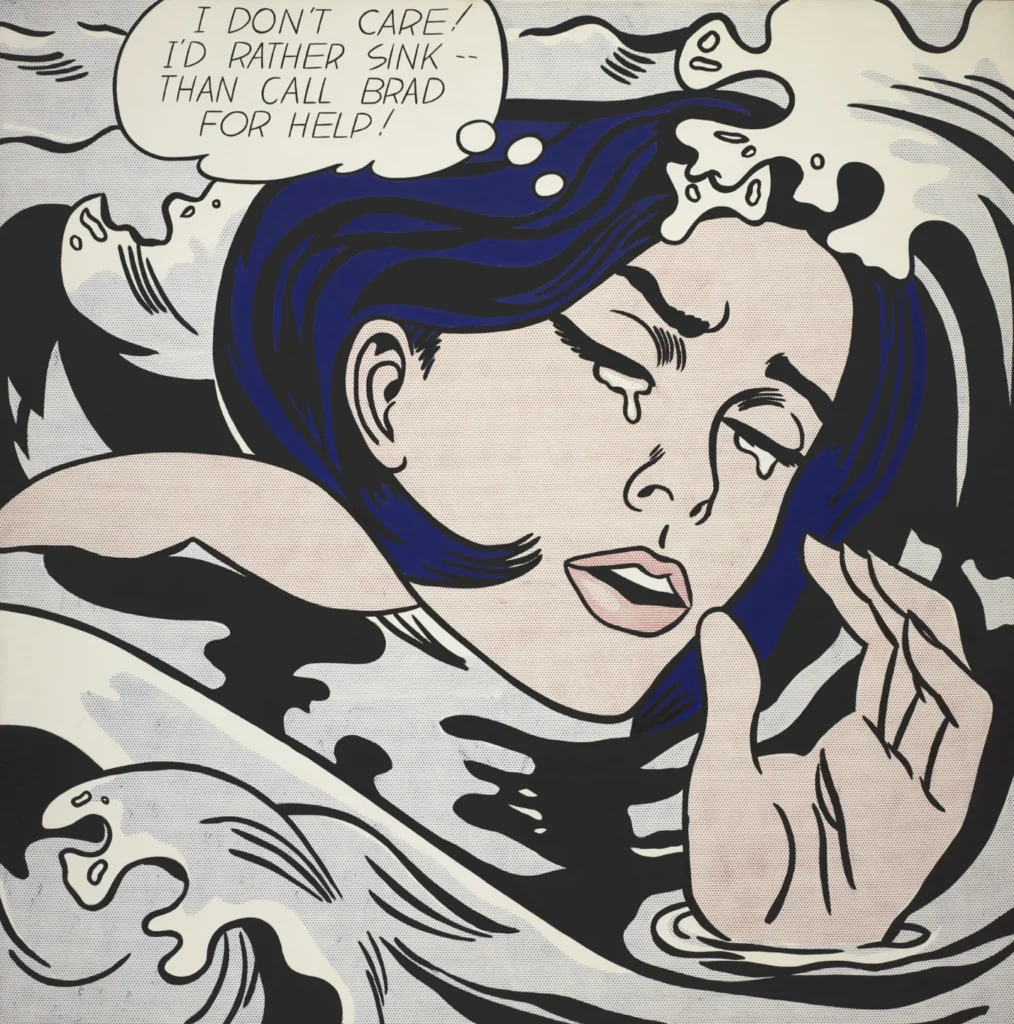
A woman struggles in swirling water, her face framed by thick outlines and the polished drama of a romance comic. Roy Lichtenstein’s Drowning Girl is more than six decades old, but a new exhibition in New York is bringing fresh attention to the painting—and the questions surrounding its creation.
Roy Lichtenstein: Like New opened at the Whitney Museum of American Art on October 11, 2026, and runs through May 10, 2027. The museum describes it as the artist’s first New York retrospective since 1993.
The artwork behind the image
Painted in 1963, Drowning Girl draws on an illustration by comic-book artist Tony Abruzzo, published in DC Comics’ Secret Hearts in 1962.
According to the Museum of Modern Art, which holds the painting, Lichtenstein cropped the original composition to isolate the woman amid a threatening wave. That act of selection changed how the scene was presented, turning part of a printed narrative into a standalone painting.
The source matters. Understanding the work means recognizing both Lichtenstein’s transformation and Abruzzo’s original contribution. It opens a discussion about where artistic invention begins—and how credit follows an image as it moves between different creative worlds.
A larger view of Lichtenstein
The Whitney exhibition brings together roughly 130 works, spanning the early 1940s through the 1990s. Alongside Drowning Girl, it includes Look Mickey, Masterpiece, and Happy Tears, as well as work in sculpture, drawing, prints, and film.
It also reunites the works from Lichtenstein’s breakthrough 1962 exhibition at the Leo Castelli Gallery, offering visitors an opportunity to reconsider the moment his Pop imagery first attracted attention.
That wider scope challenges the idea that his career can be understood through a few familiar comic-style faces.
Handmade images that looked mechanical
Lichtenstein adopted bold contours, flat colors, and patterned dots associated with commercial printing. Yet the Whitney emphasizes that these apparently mechanical images were made by hand.
The contrast is central to the exhibition’s interpretation: his paintings examine how pictures are constructed and recognized, even when their surfaces appear immediately familiar.
For today’s audiences, that creates a useful connection with everyday visual culture. Cropping, enlarging, and recirculating images can alter their meaning. A fragment detached from its original setting may become more famous than the source.
The exhibition gives that contemporary question a historical focus. Looking again at Drowning Girl means seeing an iconic painting, but also tracing the earlier image within it—and asking what was changed, what was retained, and whose work we remember.