


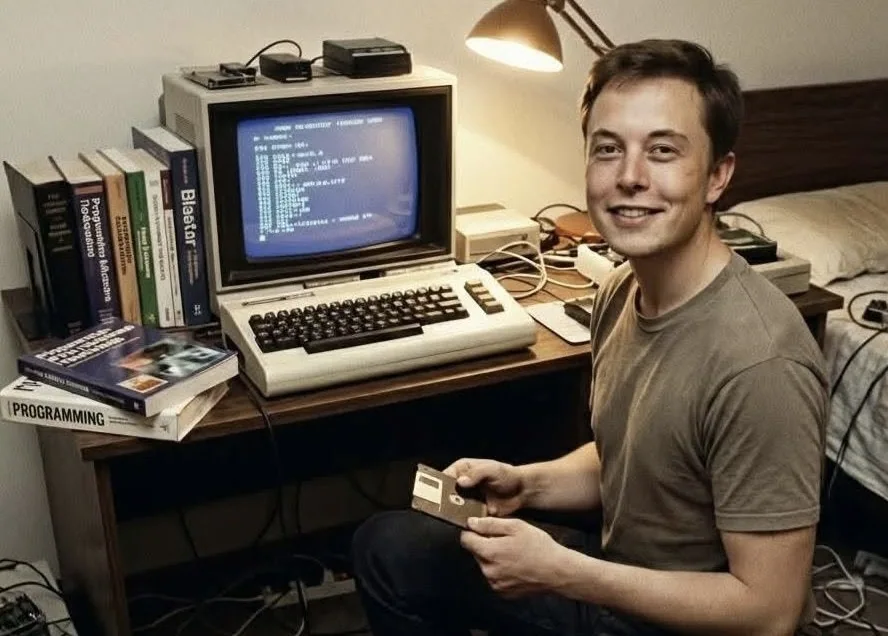
In 1995, Elon Musk and his brother Kimbal rented a tiny office in Palo Alto. The futons served as couches during meetings and beds at night. They showered at a nearby YMCA. Musk later told Wharton that renting the office had been cheaper than renting an apartment. The startup they were building was called Zip2.
The first business was a city guide
Musk had moved from South Africa to Canada in his late teens, studied at Queen’s University and transferred to the University of Pennsylvania, where he earned degrees in physics and economics. He deferred graduate study at Stanford to give Zip2 a shot. If the business failed, he figured he could go back to school.
Zip2 put local business listings and maps on the web. Newspapers were looking for ways to serve readers online, and the startup gave them software to build searchable city guides. The founders kept expenses low. They also received outside help. Their father contributed money, though accounts differ on when it came in, and a venture capital firm invested $3 million.
Musk wanted to reach consumers directly. Investors brought in a more experienced chief executive and concentrated on selling to newspapers. In 1999, Compaq bought Zip2 for $307 million, and Musk’s stake earned him more than $20 million.
From online banking to electric cars and rockets
Musk put about $12 million into his next startup, X.com. It merged with Confinity in 2000. Confinity had developed a way to send money to anyone with an email address, and the combined company took the name of that product, PayPal. Musk’s tenure as CEO ended in 2000, but he was still its largest shareholder when eBay bought the company for $1.5 billion in 2002.
The proceeds from his internet ventures helped Musk start SpaceX in 2002. In 2004, he led the first funding round at Tesla, the electric car company Martin Eberhard and Marc Tarpenning had started the previous year, and became board chair. He took over as CEO in 2008, when Tesla was still delivering its first Roadsters.
The fourth rocket made it
SpaceX’s first three Falcon 1 launches failed. On the third attempt, the first stage bumped into the second after separation. The team identified the problem and tried again less than two months later. On September 28, 2008, Falcon 1 became the first privately developed liquid-fuel rocket to reach orbit. NASA had already backed SpaceX’s cargo development work in 2006. That December, it awarded the company a $1.6 billion contract for 12 cargo flights to the International Space Station.
In 2012, SpaceX’s Dragon reached the space station and Tesla began delivering its Model S sedan. A $465 million U.S. Department of Energy loan helped finance development and manufacturing for the Model S and its drivetrain. Tesla repaid it in 2013. In 2020, SpaceX launched NASA astronauts Robert Behnken and Douglas Hurley to the station, the first crewed launch from U.S. soil since 2011.
How Twitter ended up inside SpaceX
Musk bought Twitter for $44 billion in 2022 and renamed it X. He launched xAI in 2023, and the AI company developed the Grok chatbot. In 2025, xAI and X came under the same parent company. SpaceX acquired that parent in February 2026, bringing rockets, the Starlink satellite internet business, Grok and the social platform under one corporate roof.
SpaceX began trading publicly in June 2026. Its filings show the offering brought in about $85.7 billion after fees, including the extra shares sold through the underwriters’ option. SpaceX said it intended to put the proceeds toward AI computing, launch infrastructure and its satellite networks, among other uses.
Where the story stands today
On November 9, 2026, Musk said Tesla would have to refund many Cybertruck deposits as it prepares to wind down production in mid-2027 and make room for more Cybercab robotaxis. Separately, Reuters reported that SpaceX is proposing a roughly $24 billion gas-fired power plant and computing facility in Starbase, Texas. The figure covers the estimated investment for the project’s initial phases.
In Palo Alto, the question was how long two brothers could afford to keep building software before customers or investors came through. Today, the choices are about what gets factory space, computing power and billions in capital. The scale has changed. The decision about which idea to fund next still shapes the story.
 Lebanon’s Fattal Group Becomes Tamina After CMA CGM TakeoverNovember 11, 2026
 France to Raise Minimum Wage to About €1,502 a MonthNovember 11, 2026
 Rockstar Games Returns to Vice City on November 19November 11, 2026