


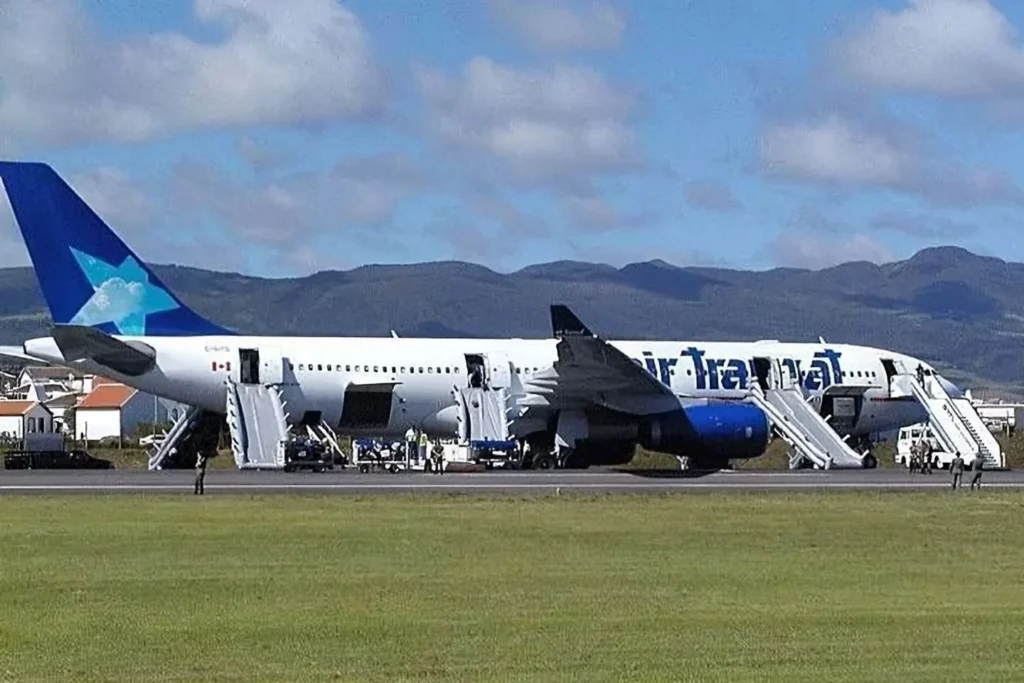
Air Transat Flight 236 was still around 120 kilometres from the nearest runway. With its fuel exhausted, the Airbus A330 carrying 306 people had become a glider.
What followed was a 19-minute descent that ended on an island runway in the Azores. Everyone aboard survived.
A routine crossing becomes an emergency
The flight had left Toronto for Lisbon on the evening of August 23, 2001, local time. During the overnight crossing, a fuel line feeding the right engine developed a leak.
As fuel quantities fell, the crew struggled to identify the problem. They diverted towards Lajes Airport on Terceira Island, part of Portugal’s Azores archipelago in the North Atlantic.
At 06:13 UTC on August 24, the right engine stopped. Thirteen minutes later, the left engine also lost power.
The aircraft was now descending towards Lajes with neither engine producing thrust. The crew warned air traffic control that a landing at sea might be necessary.
Why didn’t the aircraft fall out of the sky?
An aircraft’s engines provide thrust, while its wings generate lift as air moves around them. Losing engine power does not instantly remove that lift.
By descending at an appropriate speed, an aircraft can exchange altitude for forward motion and continue flying as a glider. Its available height becomes a finite reserve: every kilometre travelled uses some of it.
How far it can glide depends on factors including altitude, wind, aircraft configuration and speed. Reaching a runway requires careful control of that remaining energy.
The small turbine that helped keep it controllable
When both engines stopped, Flight 236 also lost its normal engine-driven electrical generation and much of its hydraulic power.
An emergency device called a ram air turbine deployed into the airflow. This small turbine supplied hydraulic power and drove an emergency generator, keeping essential systems available.
It could not propel the aircraft or restart its engines. Its role was to help preserve the systems needed to control the descent.
One approach, no second chance
Captain Robert Piché and First Officer Dirk De Jager guided the aircraft towards Lajes, assisted by air traffic controllers.
Reaching the airport created another challenge: the aircraft had excess height to lose. The crew made a full turn, followed by S-turns on final approach, to position it for landing.
At 06:45 UTC, it touched down hard on runway 33, bounced, and landed again before stopping. Without engine power, there was no opportunity to abandon the approach and climb away.
All 293 passengers and 13 crew members survived. Eighteen people were injured during the evacuation, including two who sustained serious injuries.
The investigation behind the extraordinary landing
Investigators traced the leak to contact between a hydraulic line and a fuel line following an engine replacement. The rubbing caused the fuel line to crack.
They also found that the crew’s response to the fuel imbalance allowed fuel from the opposite wing to feed the leak. Correct application of the fuel-leak procedure could have preserved enough fuel to reach Lajes with an engine still operating.
The story therefore carries two lessons: an extraordinary recovery from a life-threatening emergency, and a preventable chain of maintenance and operational failures.
Flight 236 demonstrated something many passengers never realise: when the engines stop, an aircraft can still fly. The challenge is turning its remaining altitude into a landing.
 24 Hours, Two Sunrises: Airbus’s Record-Breaking JourneyNovember 14, 2026