


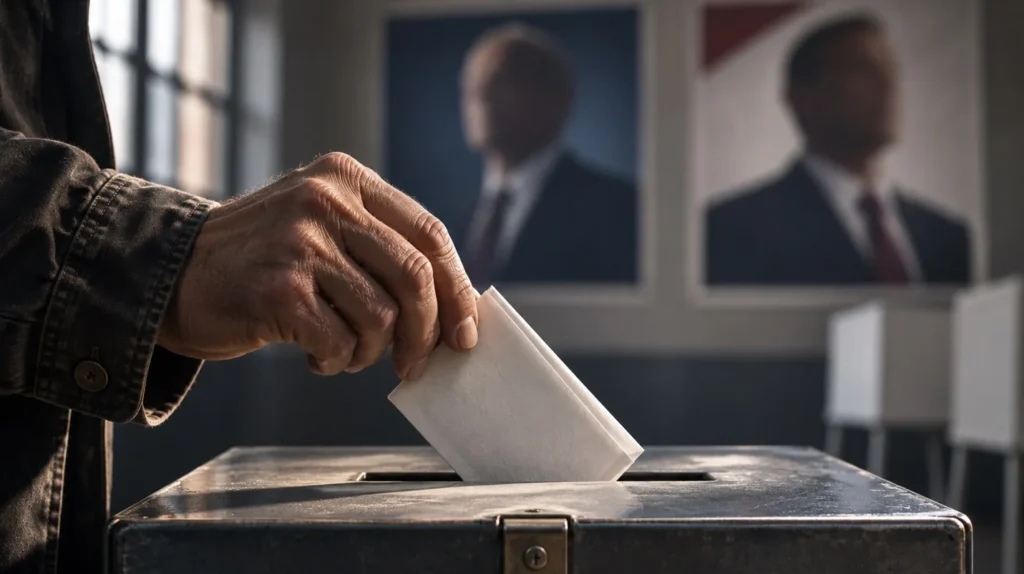
A voter can criticise a politician for years, complain about broken promises, question their honesty—and still vote for them when election day arrives.
To an observer, that may look contradictory. To the voter, it may feel like the only reasonable choice.
The explanation begins with a distinction that election results can obscure: supporting a candidate does not mean trusting them. A ballot records a choice among available options. It cannot reveal every reservation behind it.
Someone may distrust a leader’s character while believing in their economic policies. Another may dislike the governing party but fear the opposition more. A third may see no credible candidate who represents their interests.
Each reaches the same ballot box through a different calculation.
A choice between imperfect options
Elections rarely offer voters a candidate who satisfies every expectation. People must decide which shortcomings they can tolerate and which outcomes they most want to avoid.
Consider a voter who doubts a politician’s honesty but believes that politician is more likely to protect their job. Or someone who objects to a party leader’s conduct while strongly supporting the party’s position on healthcare, security, or taxation.
Their vote can express a priority rather than a personal endorsement.
A 2023 Pew Research Center survey illustrates how dissatisfaction and political alignment can coexist. Although 72% of American adults rated the quality of recent political candidates negatively, 56% said they usually had at least one candidate who shared most of their views. These findings concern the United States, but they demonstrate an important distinction: disliking the choices does not prevent someone from finding a preferred option.
The question facing such voters becomes: which compromise carries the greater cost?
When the other side feels more dangerous
That calculation becomes sharper when political opponents appear threatening.
If voters believe an election could endanger their livelihood, rights, security, or community, doubts about their own candidate may lose importance. They may support someone they consider flawed because they believe defeat would bring something worse.
Political scientist Milan Svolik examined this tension through candidate-choice experiments in Turkey, Venezuela, and the United States, discussed in a 2019 Journal of Democracy essay. Across those settings, voters penalised candidates for supporting undemocratic measures, but that penalty weakened when partisan loyalties or policy differences made rejecting the candidate more costly. These experiments examined democratic principles rather than personal trust; they nevertheless show how voters can accept conduct they oppose to protect other political priorities.
For a campaign, the implication is powerful. Convincing people that an opponent is unacceptable can make its own candidate’s shortcomings easier to survive.
For democracy, the implication is troubling. Accountability weakens when supporters believe there is no circumstance in which they can afford to let their side lose.
Trust has more than one meaning
Asking whether voters “trust” a leader can also conceal several different questions.
Do they expect the leader to tell the truth? Keep promises? Govern competently? Defend their interests? Respect the law?
A person can answer those questions differently.
A voter might expect exaggeration from a politician yet believe the politician will defend a particular policy. Another might regard a candidate as personally decent but doubt their ability to manage a crisis.
This helps explain why exposing dishonesty does not necessarily settle an election. Evidence about a leader’s character may matter greatly to one voter and fail to address another voter’s main concern.
It also explains why the accusation that supporters have been deceived can miss the point. Some may recognise a candidate’s faults and accept them consciously. Whether that bargain is wise is a separate question from whether they understand it.
The limits of “they are all the same”
Distrust can produce another response: the belief that no politician deserves confidence.
From that starting point, honesty becomes a weaker basis for choosing. If a voter assumes every candidate will disappoint, they may focus instead on party loyalty, a specific promise, or the prospect of disrupting an established system.
The danger in this reasoning is that it can flatten meaningful differences. Evidence of misconduct becomes just another example of what people already expect. A serious breach risks being dismissed as ordinary politics.
Recognising that candidates are imperfect requires judgment. Treating every failure as equivalent removes the need to make one.
What a victory actually proves
None of this means distrust has no electoral consequences. Voters can change parties, back challengers, or withdraw support. Nor does one explanation fit every political system: the choices available, the fairness of competition, and the freedom to dissent all matter.
But a winning vote total should be interpreted carefully. Within it may sit enthusiastic supporters, reluctant allies, single-issue voters, and people primarily determined to stop someone else.
For challengers, exposing an incumbent’s failures may therefore be insufficient. They must also persuade doubtful voters that an alternative is credible and that changing course is a risk worth taking.
For leaders, victory grants the authority attached to office. It does not establish that every supporter accepts their conduct or believes their promises.
The revealing question is what happens when those supporters are disappointed again. Can they demand better without feeling that they have betrayed their community, abandoned their convictions, or handed power to an intolerable opponent?
A democracy’s capacity to hold leaders accountable depends partly on whether voters feel free to answer yes.
 Before You Try That Viral Remedy, Check What’s Already in Your CupNovember 14, 2026
 The World Is More Connected. Why Do We Feel More Alone?November 14, 2026
 He Survived Hiroshima. Then He Went Home to Nagasaki.November 14, 2026