


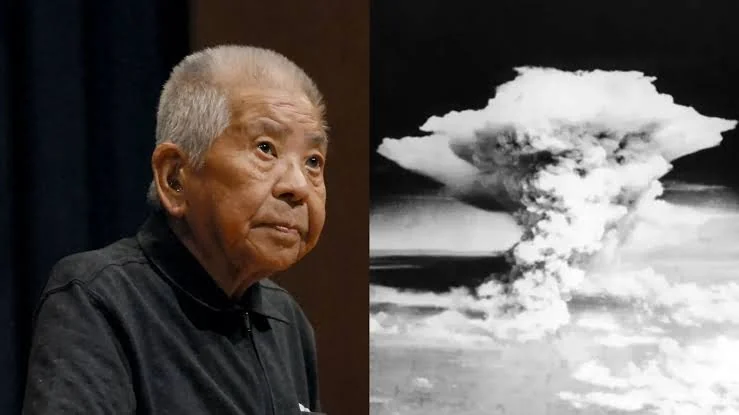
Tsutomu Yamaguchi was away on business when the first atomic bomb fell. Badly burned, he survived Hiroshima and made his way home.
His home was Nagasaki.
On August 9, 1945, while he was explaining what had happened in Hiroshima to colleagues, another flash tore through the sky. He was experiencing an atomic bombing for the second time.
Hiroshima: August 6, 1945
Yamaguchi was a 29-year-old engineer working for Mitsubishi. He had travelled from Nagasaki to Hiroshima for a shipbuilding assignment that was drawing to a close.
That morning, he was on his way to work when the United States dropped an atomic bomb on the city. He survived with severe burns to his upper body.
In his later testimony, he recalled an ordinary summer morning transformed into devastation. The journey home became a struggle through injury, exhaustion and uncertainty.
He also remembered an act of kindness aboard the train: a stranger insisted that he accept food, recognising how badly he was hurt. Amid the destruction, that small gesture stayed with him.
The journey home
Yamaguchi reached Nagasaki on August 8. His arm was badly swollen, and he sought treatment at a Mitsubishi hospital before going to see his family.
His parents were astonished by the sight of him covered in bandages. He had escaped a devastated city and returned to familiar surroundings—but only a day separated his arrival from the second bombing.
Nagasaki: August 9, 1945
Despite his injuries, Yamaguchi reported to work. As he described the destruction of Hiroshima, the United States dropped a second atomic bomb, this time on Nagasaki.
He recognised the flash and took cover beneath a desk. The blast swept through the room, scattering documents and debris.
Once again, he survived.
The sequence is almost impossible to comprehend: a man injured by one atomic bomb travelled home, only to encounter another three days later.
A life beyond survival
After the war, Yamaguchi worked as a translator and an English teacher before returning to Mitsubishi. He also wrote poetry, finding a way to express experiences that were difficult to describe.
In his later years, he became an outspoken advocate for nuclear disarmament. In 2006, he appeared in a documentary about people who had survived both bombings and spoke at a screening at United Nations headquarters in New York.
In 2009, Japanese authorities formally recognised his exposure to both attacks. Other people had also survived both bombings; Yamaguchi’s distinction was his official recognition as a survivor of each.
He died on January 4, 2010, aged 93.
The message he left behind
Yamaguchi’s story is often told as an extraordinary coincidence of survival. But his own testimony placed the emphasis elsewhere: on the people who died, the suffering that continued afterwards and the responsibility of younger generations to remember.
He survived long enough to tell the world what happened in both cities. His hope was that no one would ever have to tell such a story again.
 Before You Try That Viral Remedy, Check What’s Already in Your CupNovember 14, 2026
 Why Do People Vote for Leaders They Don’t Trust?November 14, 2026
 The World Is More Connected. Why Do We Feel More Alone?November 14, 2026