


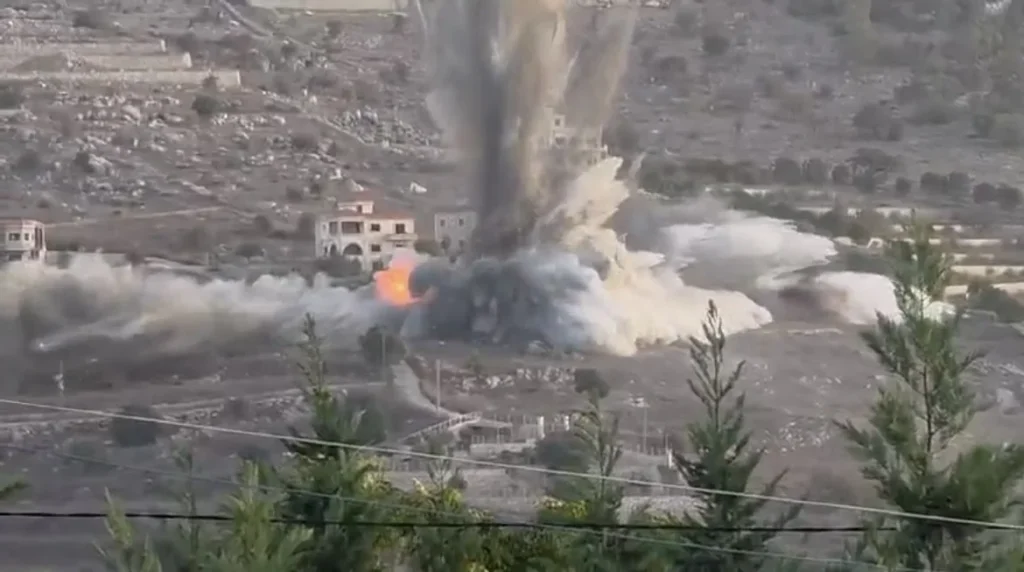
Israeli attacks in southern Lebanon continue despite months of U.S.-mediated diplomacy, leaving Lebanese leaders confronting a difficult political question: how can negotiations restore state authority while military operations persist on Lebanese territory?
Recent reporting describes airstrikes, artillery fire, and demolitions across southern towns and villages. On October 30, L’Orient Today reported Israeli demolitions of homes in Tiri and shelling affecting several areas, including Haddatha, Wadi Zibqin, and the outskirts of Kfar Tibnit.
These operations underscore the gap between diplomatic commitments and conditions on the ground.
Aoun calls for an end to the strikes
President Joseph Aoun said on October 29 that key issues in negotiations with Israel remained unresolved, including a ceasefire, Israeli withdrawal, border demarcation, and prisoner releases.
According to reporting citing the Lebanese presidency, Aoun warned that Israeli strikes undermined stability. He maintained that security concerns should be addressed through official mechanisms and coordination channels rather than military action. His comments followed working-level talks involving Lebanese, Israeli, and American representatives in Tampa on October 20–21.
For Beirut, the challenge is to turn diplomatic engagement into enforceable changes: an end to attacks, withdrawal from Lebanese territory, and conditions allowing the Lebanese Army to deploy.
The dispute over weapons and withdrawal
The June framework established by Lebanon, Israel, and the United States envisaged Hezbollah’s disarmament, expanded Lebanese Army deployment, and an Israeli withdrawal from southern Lebanon. An October briefing by the British House of Commons Library noted that implementation remained limited and that no overall timetable had been established.
The political disagreement concerns both authority and sequencing. Hezbollah has resisted disarmament without Israeli withdrawal. Lebanese officials argue that continued Israeli attacks obstruct the army’s deployment and efforts to extend state control. Israel argues that the Lebanese military has not demonstrated its ability to remove Hezbollah threats from areas covered by the framework.
Israel says its operations target Hezbollah personnel and military infrastructure or respond to attacks on its troops. That explanation remains Israel’s stated justification; it does not independently establish the circumstances or legality of every strike.
Civilians face the consequences
The political deadlock has immediate consequences for communities in the south.
In an October 29 report from Zibqin, Reuters described farmers harvesting olives with Lebanese soldiers nearby because of fears of shelling. Residents said insecurity had changed when they could work and whether they could bring their children. Israel told Reuters that its strikes targeted Hezbollah rather than civilians or the Lebanese Army.
The account illustrates how continued military activity affects livelihoods even where residents have returned.
A test of the state’s credibility
Lebanon’s leadership faces pressure to demonstrate that diplomacy can protect the population while advancing its commitment to state authority.
Continued Israeli bombardment complicates that task. It leaves negotiations vulnerable to public skepticism and gives further weight to the domestic argument over who can provide security.
The political test is therefore concrete: whether official channels can produce an observable reduction in attacks, an Israeli withdrawal, and effective Lebanese Army deployment. Until those changes materialize, southern communities remain exposed while Beirut’s diplomatic strategy faces scrutiny.
 Beirut Gets Ready to Run: Marathon Scheduled for November 29November 5, 2026
 Gold Rebounds After Sharp Selloff as Investors Weigh Rates and Middle East DiplomacyNovember 5, 2026
 HORECA Lebanon Returns This November, Bringing Hospitality Businesses TogetherNovember 5, 2026