


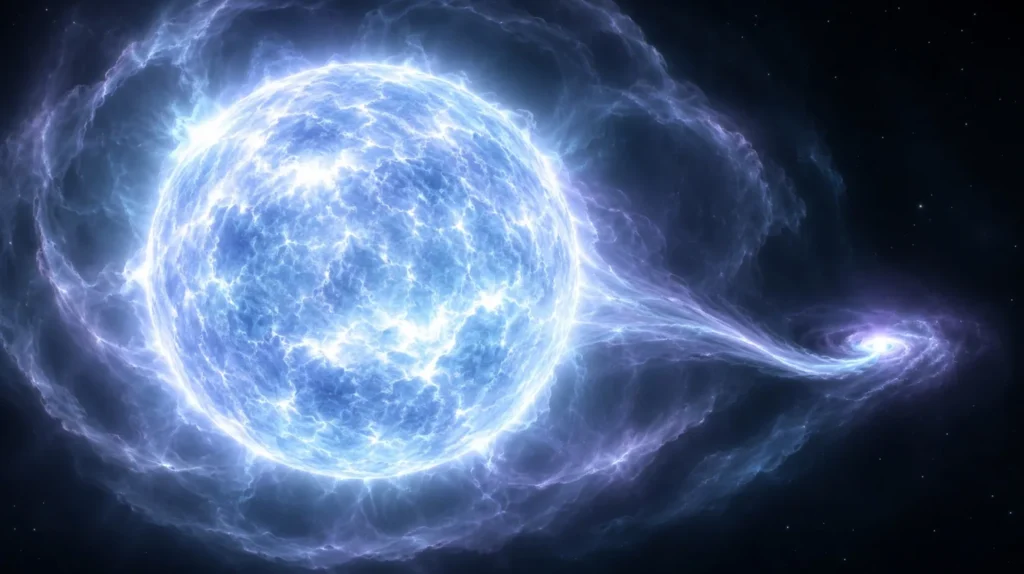
About every 113 days, a massive star 30 million light-years away flares so brightly it can look like it’s exploding. Then the light fades, and the star survives. Astronomers call it a supernova impostor. Between 2012 and 2026, they recorded at least 27 of its outbursts.
The clue was in the timing
Astronomers used the repeating pattern to point NASA’s Chandra X-ray Observatory at the star during an eruption in March 2026. It was at least 100 times brighter in X-rays than in earlier observations taken before the outbursts began. That gave researchers a way to explain why the flares kept coming back.
Their leading explanation is that the star has a companion in an elongated orbit. When the two objects come closest, the companion captures some of the material the star has shed. That material heats up and emits X-rays, which can make the surrounding gas glow brightly enough for telescopes to see.
The X-rays narrow the mystery to two suspects. The hidden companion could be a black hole or a neutron star, the dense remnant of a collapsed star. Astronomers are still working out which one.
 Elon Musk and OpenAI: How a Shared Mission Became a Public Rivalry.November 17, 2026
 A jet engine can spend years carrying passengers across continents. Its next job could be powering an AI data center.November 17, 2026
 NVIDIA’s board says it has confidence in its CEO and has no reason to believe company secrets or U.S. national security were compromised.November 17, 2026