


Before coffee became something ordered on the way to work, it had already crossed seas, entered religious life, and brought strangers together.
Its beginnings are less straightforward than the familiar story of a single discovery. There is the origin of the plant, the emergence of the beverage, and the development of the trade that carried it around the world.
Ethiopia and Yemen stand at the centre of that history. Scholarship traces their intertwined roles in coffee’s cultivation and consumption, while cautioning that popular legends often obscure the evidence.
The goats make a good story
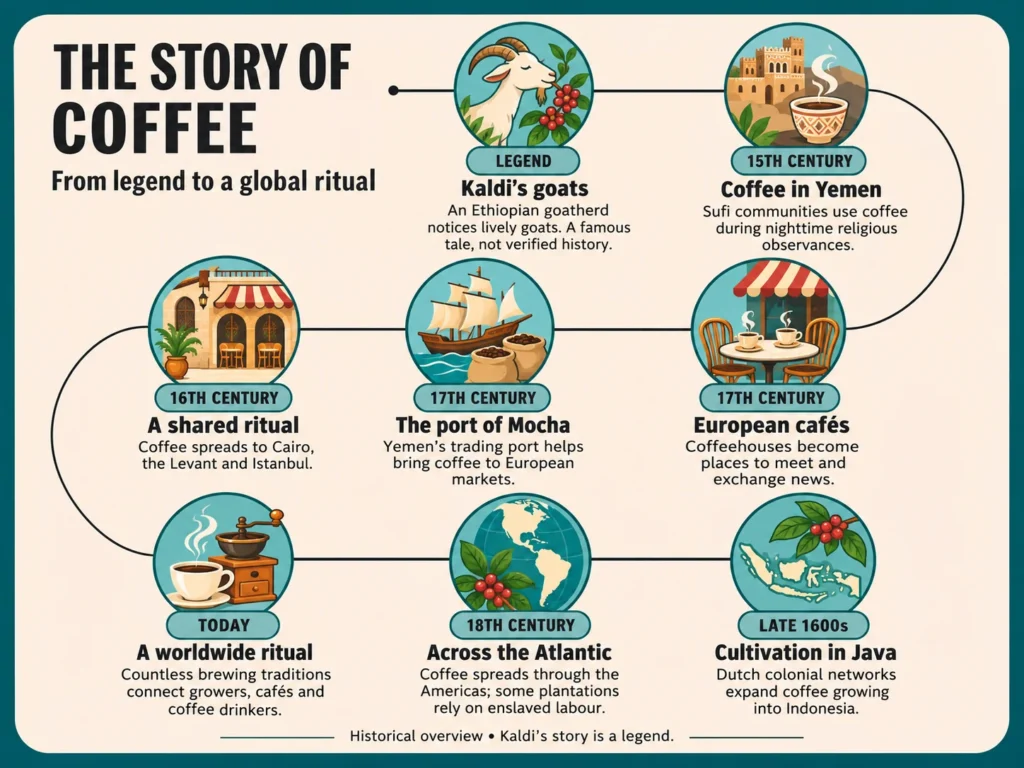
The best-known legend concerns Kaldi, an Ethiopian goatherd who noticed his animals becoming unusually energetic after eating coffee cherries.
Curious, he tried the fruit himself. In familiar versions of the tale, a religious community subsequently discovered that it could help people stay awake.
It is an appealing explanation for a drink associated with alertness. But it is a legend, rather than a documented account of coffee’s discovery. A related livestock story appeared in a seventeenth-century text, long after coffee drinking was already established.
No reliable record identifies the person who made the first cup.
Yemen gives the history firmer ground
The evidence becomes clearer in fifteenth-century Yemen, where Sufi communities used coffee to remain alert during nighttime religious observances.
The French Ministry of Culture’s historical account describes consumption within Yemeni mystical circles and its subsequent spread to Egypt in the sixteenth century. Early preparations included beverages made from the coffee seed as well as its husk.
That detail reveals how much experimentation lies behind a familiar product. Coffee did not necessarily begin as the drink we recognise today, prepared with standard equipment and a settled recipe.
People developed ways to use the plant. Those practices travelled with them.
A port behind a familiar name
Yemen also became a centre of coffee cultivation and export. Its mountainous growing regions supplied merchants, while the port of Mocha—also written Mokka or al-Makha—became closely associated with the trade.
European trading companies increasingly bought coffee through the port during the seventeenth century. The name now familiar from café menus therefore has a geographical history: Mocha was a trading place before it became associated with a chocolate-flavoured drink.
Coffee’s journey was becoming a business story. Growing demand created incentives to cultivate it elsewhere and control more of its supply.
Coffee becomes a place to meet
Merchants carried coffee through the Red Sea region and into cities including Cairo, those of the Levant, and Istanbul. Coffeehouses developed alongside its spread.
A drink could now offer a reason to sit, talk, exchange news, and return.
That remains part of coffee’s appeal. A café sells something measurable in a cup, but customers may also be seeking conversation, familiarity, or a place to spend an hour.
The commercial product and the social experience became closely connected.
The global expansion had a darker side
European colonial networks helped extend coffee cultivation into Asia and the Americas. Dutch production expanded in Java, while coffee also spread through the Caribbean.
Some colonial plantations depended on enslaved labour. Any account of coffee’s global success must therefore include the people whose forced work helped produce it.
The journey from regional beverage to global commodity involved ingenuity and exchange, but also exploitation. Both belong in its history.
A long journey before the first sip
Coffee has no single, securely documented moment of invention. Its history was built through successive discoveries: what the plant could offer, how to prepare it, where to grow it, and how to bring it to new customers.
The next cup carries traces of that journey—from East Africa and Yemen to trading ports, plantations, and neighbourhood cafés.
A drink we use to begin the day took centuries to become familiar.