


Lebanon, Founders, with Technology.
Tony Fadell helped put a music library in your pocket—and later brought his approach to an overlooked household device.
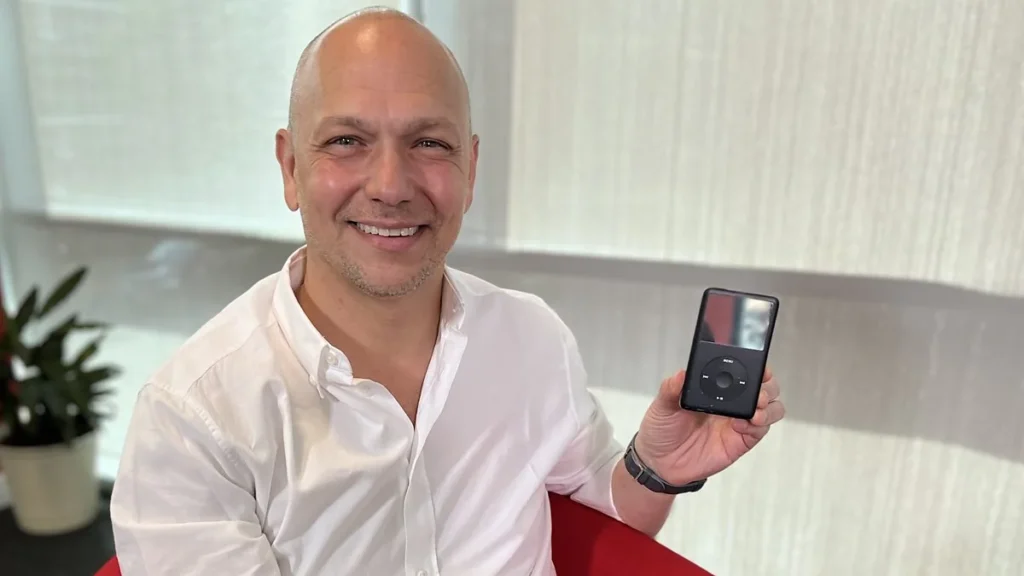
Before smartphones carried our playlists, photographs and conversations, a small music player helped change what people expected from something that fitted in their pocket.
Apple introduced the iPod on October 23, 2001. Its promise was straightforward: up to 1,000 songs in a portable device that synchronised with iTunes. It went on sale that November for $399.
One of the central figures behind it was Tony Fadell, an American engineer of Lebanese descent whose career would extend from portable music to the connected home.
The Lebanese connection
Fadell was born in Michigan to a Lebanese-American father and a Polish-American mother. His story belongs to the Lebanese diaspora, rather than being that of an engineer born and trained in Lebanon.
That connection has brought him back to the country. In 2016, he visited the Lebanese American University’s Beirut campus to speak with students about technology and entrepreneurship. The university’s account also recorded his concern about the quality of Lebanon’s internet infrastructure—a practical obstacle for a country hoping to nurture technology businesses.
His achievements offer a reason for pride, but also a question worth asking: what conditions allow technical talent to turn an idea into a product used around the world?
Behind the familiar device
Fadell joined Apple in 2001 and became a key leader of its iPod development effort. Often called the “father of the iPod,” he later served as senior vice president of the company’s iPod division.
The nickname captures his importance, but the device was a collective achievement. Engineers, designers, software developers and manufacturing partners had to bring its many components together.
What reached the customer was a simple experience: choose a song, press play and carry a substantial music collection without carrying the discs.
The first iPod combined storage, a scroll wheel and automatic synchronisation with a Mac. Its appeal depended on how those elements worked together, making digital music easier to manage and take along.
That is a useful way to understand Fadell’s contribution: helping turn complicated technology into a product people could readily use.
From music to the home
His next major venture addressed something far less glamorous than a music player: the thermostat.
In 2010, Fadell co-founded Nest with fellow former Apple engineer Matt Rogers. Their company developed a learning thermostat, applying consumer-product design to a device many households rarely thought about until they needed to change the temperature.
In January 2014, Google announced an agreement to buy Nest for $3.2 billion in cash. Its announcement identified Fadell and Rogers as the founders behind the business.
The progression is striking: from something people deliberately reached for throughout the day to something mounted on a wall.
Both required understanding how people interact with technology—and where that interaction could become easier.
A legacy beyond the nickname
Fadell’s career connects Lebanese heritage with products recognised far beyond Lebanon. Yet its international significance comes from the work itself: building teams, resolving engineering challenges and making useful products.
The iPod story is often remembered through a stage presentation, white earphones and a distinctive silhouette.
Behind those images were people who made the promise function. Tony Fadell was one of them.
 Before the Red Carpets: How Elie Saab BeganNovember 17, 2026
 The Family Transfers Behind a Much Bigger Economic StoryNovember 17, 2026
 Lebanon’s Fattal Group Becomes Tamina After CMA CGM Takeover.November 17, 2026