


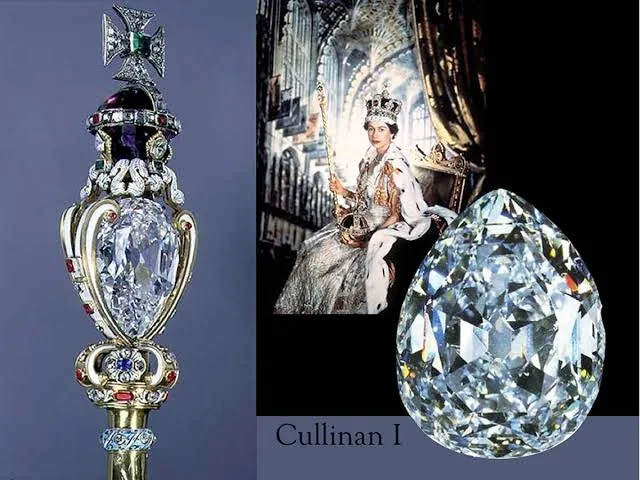
Look just below the cross on the Sovereign’s Sceptre and you’ll see Cullinan I, the pear-shaped diamond also known as the Great Star of Africa. At 530.2 carats, it holds the record for the largest colourless cut diamond. The brown Golden Jubilee diamond is heavier at 545.67 carats, so colour is part of what defines Cullinan I’s record.
Where did the original diamond go?
The original Cullinan, discovered near Pretoria, South Africa, in 1905, weighed 3,106 carats before cutting. At about 621 grams, it remains the largest gem-quality rough diamond ever found. It travelled to Britain in an insured parcel sent by ordinary post, while a replica went by ship under guard. On November 9, 1907, the government of the Transvaal presented the stone to King Edward VII for his 66th birthday.
The diamond then went to the Asscher cutters in Amsterdam. They spent four days preparing the groove for the first split. When the cutter struck, the blade broke and the diamond held. Over the next eight months, the cutters produced nine major gems from the original stone.
Today, visitors to the Tower of London can see the two largest stones from that single crystal. Cullinan I is in the sceptre, and Cullinan II, a 317.4-carat cushion-cut diamond, sits at the front of the Imperial State Crown.
 U.S.–Iran Negotiations Continue as Qatar Seeks a Path to AgreementNovember 17, 2026
 Gold Rebounds After Sharp Selloff as Investors Weigh Rates and Middle East DiplomacyNovember 17, 2026
 Will Trump Let Netanyahu Turn War Into a Political Lifeline?November 17, 2026