


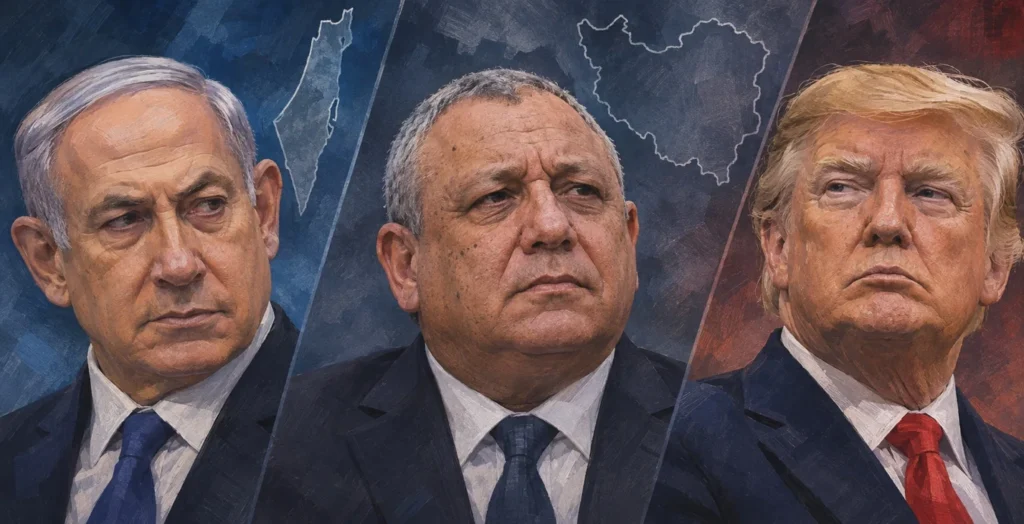
Benjamin Netanyahu remains caretaker prime minister while Gadi Eisenkot works to assemble a new government. President Isaac Herzog announced Eisenkot’s nomination after parties representing 67 lawmakers recommended him for the task. His initial government-formation period is 28 days, with a possible extension of up to 14 days.
Against that political backdrop, Netanyahu is pressing Donald Trump to resume military action against Iran. Axios reported that Mossad chief Roman Gofman visited Washington for discussions with senior American officials as part of that effort.
The convergence of those developments deserves scrutiny. Netanyahu’s political future is uncertain, yet he is advocating a military escalation whose consequences could extend far beyond Israel.
A renewed war could complicate coalition negotiations, intensify pressure for a unity government and allow Netanyahu to argue that replacing him during a security emergency would be irresponsible. These are possible political effects, not proof that personal survival is his motive.
Nevertheless, that concern cannot simply be dismissed. Netanyahu himself linked the Iranian threat to the need for a national unity government in remarks on November 14, arguing that such a government was necessary to confront it.
The legal distinction is crucial. War does not automatically terminate Eisenkot’s opportunity to form a government. Nor does it grant Netanyahu an indefinite term. The outgoing government continues until a new one takes office; failed coalition negotiations trigger further procedures that can ultimately lead to another election.
The danger, therefore, is political: an emergency could make the transfer of power harder even while the formal process continues.
Trump’s response matters enormously. Reuters reported on November 14 that he had told advisers he might avoid further attacks unless Iran or its Houthi allies provoked the United States. That suggests hesitation, although it does not amount to a binding commitment against escalation.
Will Netanyahu succeed? There is no reliable answer yet. He cannot determine Trump’s decision, Eisenkot’s coalition negotiations or the consequences of another conflict.
But the question Washington must confront is clear: does renewed military action serve a demonstrable security objective, and have its risks been justified independently of the political interests of the leader requesting it?
The possibility that war could benefit Netanyahu politically demands scrutiny. The lives of people across the region should never become bargaining chips in a struggle to remain in office.
 U.S.–Iran Negotiations Continue as Qatar Seeks a Path to AgreementNovember 17, 2026
 Gold Rebounds After Sharp Selloff as Investors Weigh Rates and Middle East DiplomacyNovember 17, 2026
 Why Are Countries Building Underground?November 17, 2026