


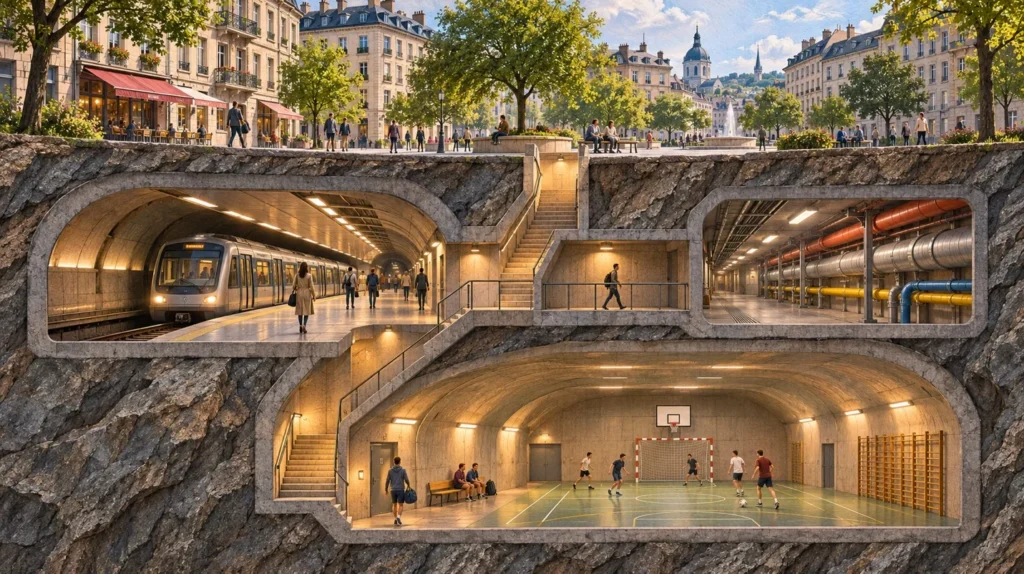
Beneath familiar streets, another layer of the world is taking shape: shelters, transport networks and infrastructure designed for pressures above ground.
In Helsinki, going underground can mean going swimming.
The Finnish capital has spaces carved into rock where people exercise and spend their leisure time—facilities that also serve a second purpose as civil-defence shelters. Some metro stations are equipped to provide protection in an emergency, too.
It is an unusual combination: everyday life and emergency preparation occupying the same space.
Elsewhere, governments are looking below ground for different reasons. Switzerland maintains an extensive shelter network. Singapore uses underground space to accommodate infrastructure while preserving scarce land above it.
These projects do not amount to one coordinated global race. They reveal several pressures pushing planners in the same direction: security, limited space and the need to keep essential systems functioning.
Preparing for a dangerous surface
Switzerland’s approach rests on a striking principle: every resident should have a shelter place.
The country has approximately 370,000 private and public shelters, providing capacity in principle for its entire population, although local gaps remain. Maintaining these spaces requires preserving their protective structures, doors and ventilation systems—even when they have other uses in peacetime.
Much of this infrastructure predates today’s conflicts. Renewed concern about European security has brought fresh attention to maintaining it. Reuters reported in December 2024 that Switzerland planned to modernise its ageing shelter network amid heightened uncertainty following Russia’s invasion of Ukraine.
The lesson is less dramatic than a hidden bunker: preparedness takes decades of planning and continued maintenance.
A shelter people already use
Finland offers another answer to an obvious problem. How do you justify building large spaces for an emergency that may never arrive?
Make them useful beforehand.
Helsinki’s underground recreational facilities demonstrate how protected spaces can remain part of ordinary city life. Finland has required shelters by law for more than 70 years; their existence reflects sustained policy rather than a sudden prediction of disaster.
International interest is substantial. In May 2026, Reuters reported that around 800 foreign delegations had visited Helsinki’s Merihaka shelter, with buyers increasingly concerned about conflicts in Ukraine and Iran.
A functioning facility also gives authorities something practical to inspect, maintain and prepare for conversion when needed.
Sometimes the pressure is simply space
Singapore’s underground ambitions address a different challenge: finding room.
Its Urban Redevelopment Authority describes underground development as a way to free surface land for housing, parks and community spaces. Its 2025 planning proposals included exploring deep caverns for storing construction materials.
This is urban planning with a vertical dimension. A city can expand upwards, outwards—or place suitable functions beneath its streets.
But underground space must be organised carefully. Singapore coordinates long-term infrastructure plans to reduce conflicts between projects, preserve room for future systems and avoid repeated excavation.
What appears empty beneath a city may already be crowded with competing needs.
Underground does not mean invulnerable
Depth alone is no guarantee of safety.
A recreational cavern, a transport tunnel and a protective shelter have different requirements. Underground facilities need appropriate ventilation, drainage, fire protection, emergency exits and maintenance. A space designed for one purpose cannot automatically provide protection against every threat.
Nor is underground construction equally practical everywhere. Geology, existing buildings and cost shape what is possible. Aalto University researchers note that Helsinki’s demand for space and relatively low skyline can make underground development viable despite its expense.
What the underground reveals
These projects say something about how countries imagine their future.
Some are making room for growth. Others are preserving places to protect people. Many are trying to ensure that infrastructure continues to serve a city under difficult conditions.
The questions deserve public attention: who can access the protected space, how quickly can it become operational, and who pays to keep it ready?
The most revealing part of an underground project may be what happens above it—the decisions about land, public safety and whose needs deserve long-term investment.
 U.S.–Iran Negotiations Continue as Qatar Seeks a Path to AgreementNovember 17, 2026
 Gold Rebounds After Sharp Selloff as Investors Weigh Rates and Middle East DiplomacyNovember 17, 2026
 Will Trump Let Netanyahu Turn War Into a Political Lifeline?November 17, 2026